

Consumer Canons
Why is our food so similar?

The American food consumer landscape is dominated by a bevy of standardized, immutable product flavors. In ice cream: strawberry, vanilla, cookies and cream, mint chocolate chip, and cookie dough dominate. In potato chips: sour cream and onion, salt and vinegar, and BBQ are an unconquerable dynasty. In candy: lemon, lime, orange, and strawberry are permanent institutions. No matter the supermarket, no matter the region, no matter the target demographic, these product canons are omnipresent.
On its face, isn’t it just a bit weird that both Coca-Cola and PepsiCo offer lines of root beer and lemon-lime soda in addition to their titular colas? That every ice cream maker produces a flavor as niche as butter pecan? Why does my regional grocery store feel compelled to offer generic versions of Dr. Pepper and Mountain Dew? Where is the experimentation? Where is the variety? What enforces this rigid homogeneity that permeates consumer offerings?
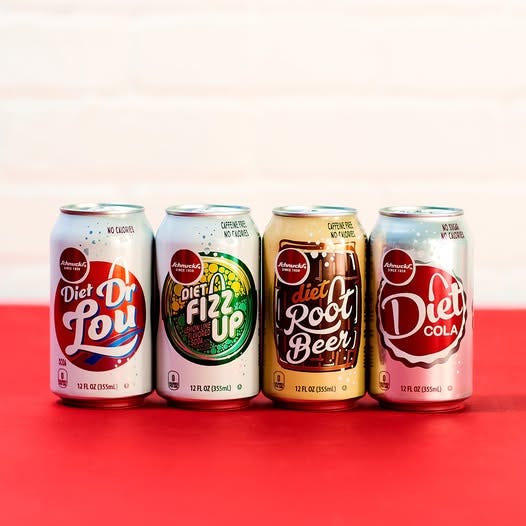
A number of economic and behavioral forces shape the marketplace and the kinds of products that reach supermarket shelves. One of these is a concept called market substitution. The crux of this idea is that when goods are sufficiently similar in price, nutritional qualities, and taste, consumers tend to view them as interchangeable. This is why, when a restaurant only offers Pepsi, even if you would have preferred a Coke, the item on offer is close enough that you order it anyway.
When a product rises in popularity in the marketplace, competitors want to be in a position so that they are the default substitute. This can be accomplished by establishing a “perfect” substitute that, because of its similar level of brand recognizability or quality, can be priced similarly to the market leader. Alternatively, substitution can be achieved by selling an “imperfect” generic version that, due to not needing to market a proper brand, can still attract a customer base through low prices. Following the standard model defined by market pioneers can allow companies to peel off customers from incumbents.
This is also why substitutes tend to show up most in areas where the market power of alternative players can be flexed, such as in grocery stores where the retailer controls the shelf space and can commission a white-label generic to compete with flagship brands that would otherwise dominate. Pepsi accomplishes something similar by offering favorable terms for soda fountain rentals to restaurants for exclusivity agreements.
Another space where market power drives standardization is something called the brand matching effect. Here, brands with a lot of recognizability will offer complementary products alongside their signature creation. Think Tostitos marketing salsa and queso alongside their flagship tortilla chips. As consumers begin to expect these combinations, makers of substitute chips also begin making substitute pairings as well, offering the same salsa con queso, white queso, and salsa temperatures as the market leader.
Beyond the interplay between benchmarks and challengers, outside forces also drive standardization. Suppliers, for example, offer uniform ingredients and paraphernalia. Due to their scale, standardized pathways are created that companies must follow. This shows up clearly in food containers. Beer, for example, is often sold in the same kinds of cans, bottles, and boxes as all the other brands on the market, as these are what manufacturers offer and what distributors and retailers are expecting as they plan out truck, storage, and shelf space. The dominance of the long-neck beer bottle made possible by the scale of the U.S. consumer market is why Canadian brewers were forced to abandon the stubby bottles they historically used, as they became expensive due to the lower unit sales of the smaller Canadian market.1 Deviations from these standard models tend to come from higher-end items, like top or medium shelf liquors that can afford to purchase custom bottles and use their unique shape as a marketing tool.
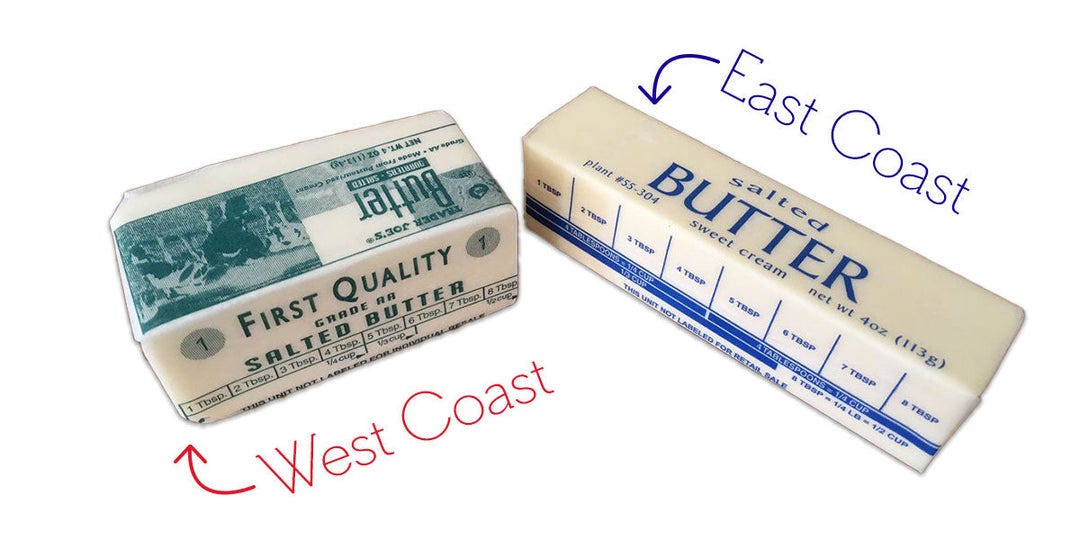
Curiously, standardization can also be a source of regional variation. In butter, historic, regional differences in available machinery led to two distinct stick shapes in the U.S., the longer Elgin in the east and the shorter Western Stubby covering the Pacific states. Inertia from grocers' unwillingness to reformat their dairy sections forces today’s post-regional dairy concerns to utilize two types of butter printing machines in their manufacturing plants.
Finally, there are cultural forces within the food industry that uphold uniformity across categories. The companies locked in a Sisyphean cycle of trend chasing go to the same conferences, read the same reports, and talk to the same consultants. As Mike Lee documents, this consistency of information results in firms pursuing the same next big ingredients and health fads. This is why protein is stuffed in every nook and cranny of the grocery store and dusty boxes of Dubai chocolate litter gas station counters from Atlanta to Minneapolis. It’s hard to get the green light for a product launch from senior management unless you have research to back up whether you have legs in the marketplace. If the talking heads are all pointing in similar directions, no one is going to take the risk of breaking with convention.
These paths that lead food companies to the same destinations are a large part of why the consumer landscape can feel stiflingly repetitive at times. The innovation that does happen feels gradual, with new products maybe playing with taste or form, but never both. At Taco Bell, the Crunchwrap evolved the form of tostadas and tacos, but kept the core ingredients the same; however, for the Dorito locos taco, they changed the ingredients but kept the form consistent. When something transformational does pop up, such as functional sodas,2 it’s either bought up by the food majors or duplicated to death, becoming a new mainstay based on new standardized conventions.
I do believe there is space in the market for more variety in flavor, texture, and ingredients. More competition and less concentration is a perennial recommendation that could encourage bigger R&D budgets and more risk-taking on new products. Less concentration could also help nurture regional brands that trade in distinct local flavors. A Midwestern brand that hawks Pawpaw ice cream or black walnut cookies would be quite welcome in my household. Finally, investing in breeding programs that develop and perpetuate new and heirloom produce, grain, and livestock varieties is an effective way to build out more and varied flavors among ingredients.
Surpassing these sorts of structural reforms from the grassroots, we can seek out and evangelize unique flavors, both local and exotic. All my friends can attest that I have been doing my part by nonstop blabbering about these Cattle Beans. Patronizing marketing channels that are distant from centralized supply chains, such as Food Hubs or farmers’ markets,3 is another way to find new culinary experiences, as are international grocery stores. Restaurateurs and independent grocers can also tap into neglected flavors by building products from local farmers and regional food companies into their offerings.
Food is an enormous part of culture, and the pervading sense that a confining monoculture is descending upon us, flattening out our regional accents, sucking the personality out of the built environment, and standardizing our food culture. There is space in a scaled food system to encourage more novelty, creativity, and innovation. It’s also worth recognizing that, as eaters, a lot of us are content with available flavors and are not seeking out endlessly new experiences. The market can only bear so much diversity. But I still think it’s a worthwhile endeavor to inject more creative capacity into the food system and release the energies of the nation’s food scientists and local gastronauts.
What I’m Reading, Watching, and Listening to
The James C. Scott Memorial Episode: Statecraft discuss the work of one of the 21st centuries most important thinkers. They discuss Scott’s work on how non-state peoples interact with states, how geography and crop selection defines how susceptible people groups are to state incursions, and how governments attempt to expand their scope by fabricating access to information. This is a really good primer.
I read a ton of patriotic magazines to learn about American Culture: Quite an informative survey of the America 250 issues of dozens of magazines, from People to Jacobin to Motortrend. I really enjoyed learning about how all these different segments of the intelligentsia thinks of where we are and how we got here
Though these are being brought back through nostalgia-driven campaigns by both various Canadian brewers and by Coors.
A concept I deeply despise, not everything enjoyable needs to be doing something for you other than bringing pleasure!
The scaled and unscaled versions of this strategy, respectively.
American eaters do seem to be content with available flavors and don’t as you note seek out endlessly new experiences. But it’s also been my observation these eaters have lost touch with the seasonal variations in agriculture production. My biggest problem with our American food scape is monotony. All the superficial variety in packaging and messaging ends up tasting pretty much the same to me. Enjoy your perspectives on the American food scene.
Agree. Also think that when there is a declining and already little number of people who grow food in any capacity, there is a surrendering of their connection to food and the flavors of the land they dwell upon. In this condition of disconnection from production, economies of scale and annual R&D conferences dictate consumption.