

Data Centers are Radicalizing People Against Clean Energy

The data center backlash has dominated the American political landscape this year and is quickly rising to become the defining environmental and land-use issue of the 2020s. Strains on infrastructure and rising energy bills have sparked a utility reform movement, driving legislators in Wisconsin, Pennsylvania, and Virginia to introduce legislation to protect citizens from bearing the burden of these investments.
Unfortunately, the damage of this build-out isn’t limited to drained aquifers or contentious zoning meetings. Solar and wind projects are getting caught up in the outcry as well, threatening the nascent transition away from fossil fuels.
Numerous grassroots groups are drawing connections, with unclear logic, between data centers and green energy projects, namely solar and wind farms and transmission lines. One group, Save Our Sunsets Oklahoma, highlights this focus on their ‘About’ statement:
“Save our Sunsets is a grass roots group started in Payne County to advocate for personal property rights. The group also provides information and resources to property owners on impacts to property of industrial scale “green energy projects” (solar, wind, data center, and associated high power transmission lines) that are not communicated or are minimized by so called green energy companies. Efforts include reaching out to and advocating for property right protections with local, county, state and federal officials.”
Note the bizarre choice to classify data centers as a type of green energy project.
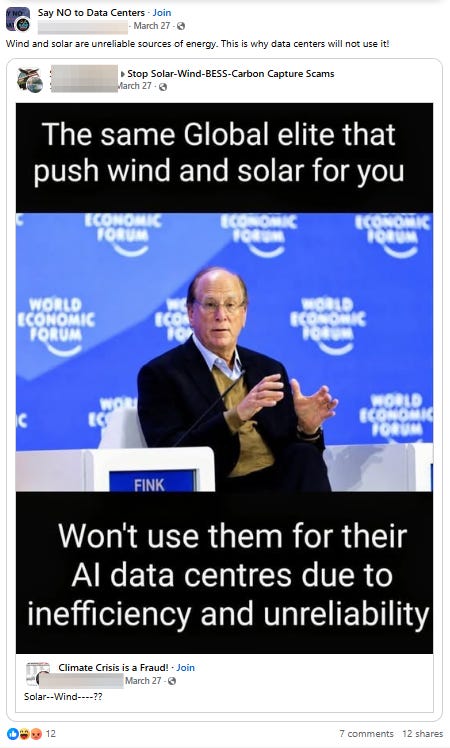
Posts in web forums also tend to conflate the two forms of development. In Arkansas, several local Facebook groups have been established opposing these projects, often with little distinction between green projects and data centers. One group, Stop Wind, Solar & Data Farms Carroll County, has over 2,000 members, and NO Wind Farms, NO Data Centers Buffalo River Country has around 1,300. These groups contain a mix of local project updates alongside clips of contentious town meetings across the country.
Politicians often blur the lines between these projects as well. Michigan weirdo and gubernatorial candidate Tom Leonard said in a video posted on Facebook
“Here’s the truth [proceeding to lie] these massive industrial solar projects are not here by accident. They are being driven by the explosion of AI datacenters.”
Leonard cites a report from The Midwesterner, which discusses a study assessing land conversions from farmland to green developments, among other projects. Leonard claims 500,000 acres of farmland were sold to build solar farms to just power data centers, when in actuality, the report states that 500,000 acres total in THE LAST DECADE were developed into solar farms. This spurt in development doesn’t really match up with the data center boom.1
Now, there are situations where clean energy projects are connected to data centers (which is confusing, as these groups often float claims that developers are pushing wind and solar onto average citizens to hoard “reliable” and “efficient” fossil energy sources for themselves). OpenAI’s Stargate project is seeking to build out large solar parks to power a new spate of hyperscalers, and Google is pumping almost half a billion into Fervo Energy to access new geothermal resources.2
Other times, the situation is far murkier. In one Virginia community, a proposed Google data center entered into an agreement with a local wind developer to purchase electricity from then-under-construction turbines. A local politician implied in an interview that “many residents did not understand the connection between the wind farm and the data center until after key announcements were made,” and that “people want to take our mountains from us to harness that wind for somebody else’s profit,” insinuating that Google and the wind developer colluded to conceal the relationship between both projects. But the wind farm was approved in 2016, long before the data center building spree, and the landowner and the county at large seem to be well compensated through land payments and taxable income. I don’t think the developer, Apex Energy, should be prioritizing data centers as customers either, but calling the wind farm project approval process opaque is a dishonest framing. Yes, the data center should be stopped, but the wind project was in no way planned to serve them.
The past misdeeds of green energy developers are often compared to the chicanery of data center developers in this rhetoric. In the early days of energy development, many landowners got shafted with low lease payments, or the developer failed to fund cleanup once the project came to an end. But it’s crucial to remember that, aside from transmission lines,3 green energy projects don’t have access to eminent domain. Nobody is being forced to put turbines or panels on their land, and we can easily implement rules to ensure that developers bear the brunt of costs and landowners get the information they need to decide whether a lease is right for them. And unlike data centers, wind and solar projects don’t strain local power grids or aquifers. They’re actually useful.
Regulating the roll-out of green infrastructure is a straightforward proposition. Illinois requires leases include an agreement specifying how they will limit damage to land during construction and operation, and the state Department of Agriculture will even mediate disputes. Oklahoma Extension publishes resources to aid farmers in understanding wind leases. And Minnesota has passed legislation giving landowners more control over their property that allows those bordering wind farms to demand a buffer between developments and their property lines. This law even enables the formation of cooperatives that spread energy development revenue between neighbors. Given the potential for much-needed wealth creation in the countryside, such policies can maximize the economic benefit of these projects for small towns and rural counties.
But because many groups cast green infrastructure as being equivalent to data centers, real benefits can be sidelined, and obstruction becomes a more acceptable playbook. They don’t push for reforms, nor do they care that many family farms have been saved by wind projects, or recognize the very real need to switch to sustainable sources of electricity.
The politics surrounding these issues is such a morass. On the one hand, you have YIMBYs who want to make constructing good, necessary infrastructure like housing or train lines easier. But fossil fuel proponents are trying to hijack that momentum to further deregulate oil drilling. Many folks have legitimate apprehensions; perhaps they had a neighbor get burned by a bad contract, or are concerned about migrating birds confusing a solar field for a lake. Maybe, like a relative of mine, they got screwed over by a fossil fuel project and are reluctant to have any energy company ever set foot on their land again. But these reasonable concerns are then drowned out by ridiculous NIMBYs resistant to any and all change, who would rather keep our country hooked on oil and their county’s library falling apart so they can look out over their neighbor’s corn field, where most of its output feeds inefficient ethanol production, without having to see an “ugly” wind farm. So much of this conversation is infected with parrot insane culture war lies about solar and wind. Adding data centers to this rhetorical mess has only accelerated the conversation's futility.
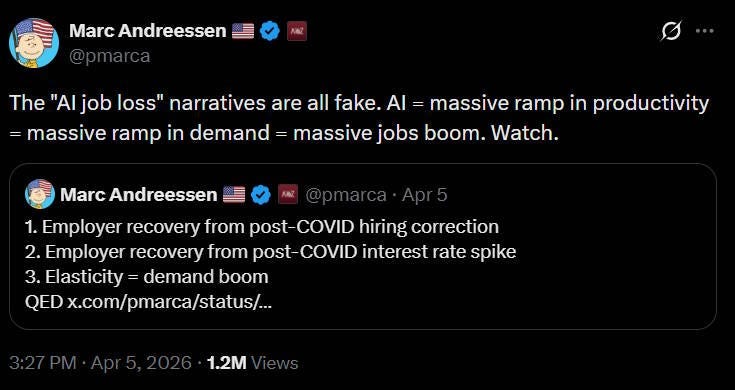
Data center proponents employ the language of social responsibility in pushing their projects. They claim their models are essential to building a thriving society, and that their demands for our land and water are a reasonable sacrifice for the greater good. This breeds a reflexive distrust towards genuinely beneficial housing, transportation, and energy projects. Poisoning the well for actually useful infrastructure.
Green energy is, plainly, both actually useful and sorely needed for the green transition. There’s simply no comparison. As a democracy, nothing is stopping us from choosing to build useful infrastructure while rejecting projects that impoverish our communities in favor of the wealth of the few. But to do so, we need to begin agreeing on what counts as a beneficial project. Until then, our planning processes will continue to sputter, directionless in the face of public that can’t distinguish between clean energy and a polluting money pit.
What I’m Reading, Watching, and Listening to
Why American Houses Are So Flimsy: American construction standards are downstream of natural resource availability, which structures our labor force and building styles around wood frame houses. Contrasted with other nations like the U.K., which have a dearth of available timber, geography is a major force defining why our homes are the way they are.
Setting the record straight — Calley Means: MAHA is coming for Marion Nestle, a gem of the food justice world, with smarmy lies. Nestle corrects the record.
The Midwesterners report is also quite flawed. They identify solar and wind projects as the focus in the headline, but the body of the article brings up housing developments and farmland investors, lumping all of these assorted land transitions together, making it very confusing to tease apart actual trends. With the omission of percent changes in land use, this article strikes me as a tad sensationalist
If any good comes from this, it would be next-gen geothermal becoming commercially viable. Maybe that will be the silver lining once this storm clears.
Transmission lines are another interesting bugbear. This faction tends to believe they are some sort of hyper-profitable lines of business and that their ability to use eminent domain represents some sort of theft of private land. But the truth is transmission lines aren’t all that profitable. Utility companies make their money not based on the volume of electricity they sell, but as a function of how many infrastructure projects they complete. Since their profits are set by regulators as a fixed return on equity, engineering more projects and subsequently growing the volume of equity they possess is their main source of profit. This makes them favor investing in high-margin local projects, like low-voltage transmission lines, instead of the cheaper-to-build high-voltage transmission lines necessary for the green transition. Since utilities don’t really profit off these projects, it isn’t really a concern that we use eminent domain on them. Should we nationalize our utilities and zero out profits from these monopolies anyway? Yes. Should we reform eminent domain? Absolutely. But high-voltage transmission lines are not the devil we should be setting our sights on.