

Demand Convenience

One of my favorite YouTube channels is Reject Convenience. The core premise of the channel is; to engage with the modern technological landscape, consumers need to contend with the tradeoff between convenience and privacy. To be a consumer of any tech product, be it for navigation, entertainment, productivity, or even health, is to cede a treasure trove of data about your lifestyle, habits, and personal thoughts to the Charybdis that is Silicon Valley. The channel focuses on educating consumers about how their privacy is at risk online, available alternatives, and evaluating privacy tools, such as VPNs.
More generally, the zeitgeist (at least as delivered through my algorithms) is beginning to idolize ‘intentional friction.’ In a rejection of productivity culture and the call to constantly optimize our lives, a counter-trend is emerging that seeks to slow down and return friction to our daily lives. Psychologists point out that some forms of friction, such as using physical media or taking more quiet time for oneself, can make experiences more meaningful and provide an opportunity for growth. Everything-handed-to-you-style luxury is an empty and unsatisfying experience.
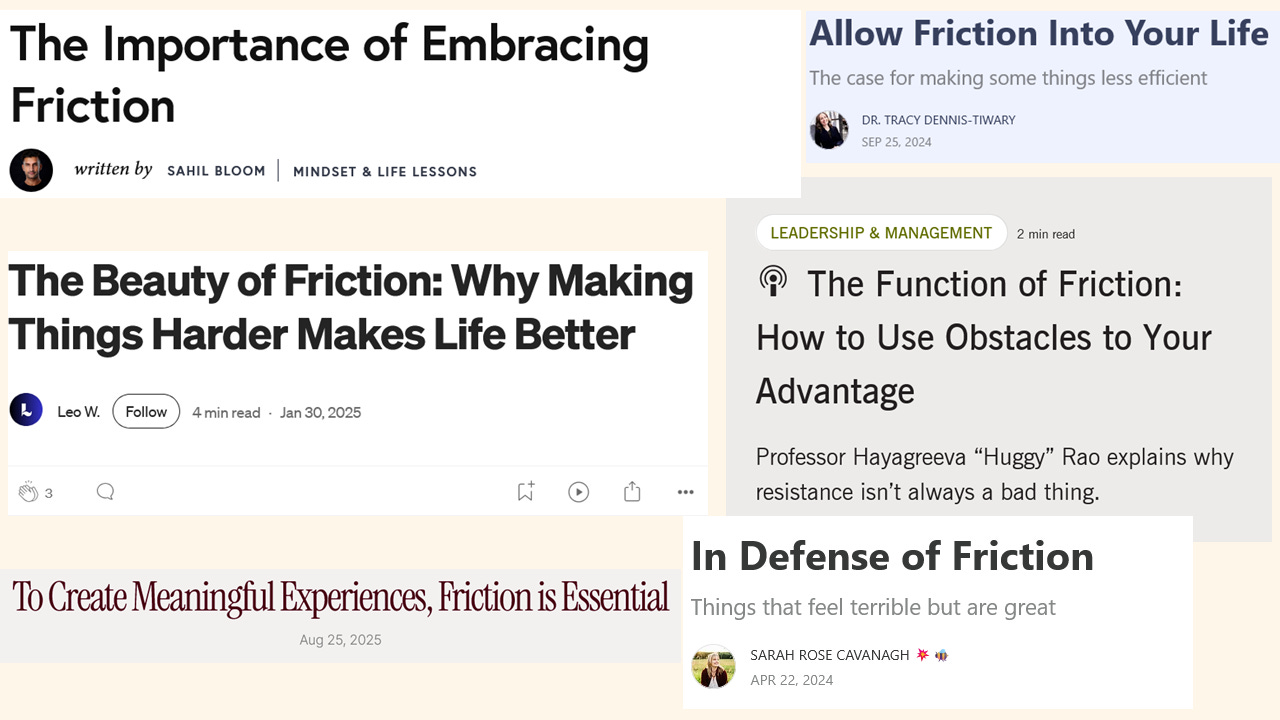
Moreover, frictionless experiences on the internet or in consumer settings lead to vapid, passive consumption, preventing us from thinking critically about and searching out the goods and services we actually desire.
These are all astute observations. Convenience is being used to trap us into passive consumerism, haplessly accepting the strictures of our corporate overlords. However, in embracing a ‘reject convenience’ ethos, I fear we may be losing the impetus to demand a better world. If the options are to either endure enshittification or withdraw from the marketplace entirely, we are, in a sense, capitulating. As consumers, we should demand a marketplace that works for us, not one that we negotiate with. We should demand convenience!
Many of the technologies that trade in convenience are incredible improvements to our daily lives. Google Maps has revolutionized navigation, being rich in features such as showing live traffic conditions. Shared documents make collaboration far less nightmarish compared to the days of sending marked-up Word documents back and forth.1 The functionality of navigation or cloud collaboration doesn’t hinge on pilfering our data. Navigation apps can deliver live traffic information without using that data to serve ads. We can have email clients that don’t snoop on our conversations, cloud office suites that don’t read our writing. It is technologically feasible to store and utilize this data to provide these useful features and not use said data for nefarious purposes. These asks are possible.
Streaming is another development that holds a lot of promise with considerable drawbacks in the current implementation. While it’s in vogue nowadays to claim that cable or physical media was better than streaming, on the merits, I still think streaming is by far a superior experience. You can choose when and where to watch, and I find it easier to discover new shows or artists. Heck, it’s fine to have ad-supported tiers to give consumers cheaper options. Cable had ads, as did DVDs. Streaming as a technology doesn’t require us to pay artists like garbage, erode union power, centralize content under a few corporate umbrellas, shoehorn movie-level concepts into eight-episode series, or nuke finished movies for a tax write-off. These are behaviors we’ve attached to the technology and are not inherent to the technology itself.
On the hardware side, there are several egregious products that could be so much more consumer-friendly, with smart appliances at the center. Many of the features on smart appliances are vapid, over-engineered solutions to ‘problems’ that can be solved by a pen and paper or remembering to turn off the AC when you leave for work. However, some features are quite enticing and even pro-social. Smart fridges can monitor their internal temperature, making micro-adjustments to the level of refrigeration, decreasing energy use. Smart laundry machines and dishwashers, likewise, can be scheduled to run when electricity rates are lowest, saving consumers money.
Critically, many of these functions don’t require an internet connection. And even for those that need to draw information on, say, electricity prices, the device doesn’t need to send data on our daily habits to the manufacturer. It’s a multi-thousand-dollar appliance; they don’t need a couple more cents from selling data on how often I do laundry. Finally, these machines can be designed to operate like normal appliances when the computer breaks or the internet goes down. There’s no reason smart beds should be malfunctioning when servers crash. Smart appliances absolutely could be designed as mechanical devices first with computer augmentation on top, maximizing functionality. Manufacturers simply choose not to.
Instead of reverting to the technologies of the past2 or forgoing modern conveniences entirely, consumers should demand durable, functional, and privacy-respecting products. The solution is not to give up on innovation, but to reform the role technological advancements serve in the marketplace.
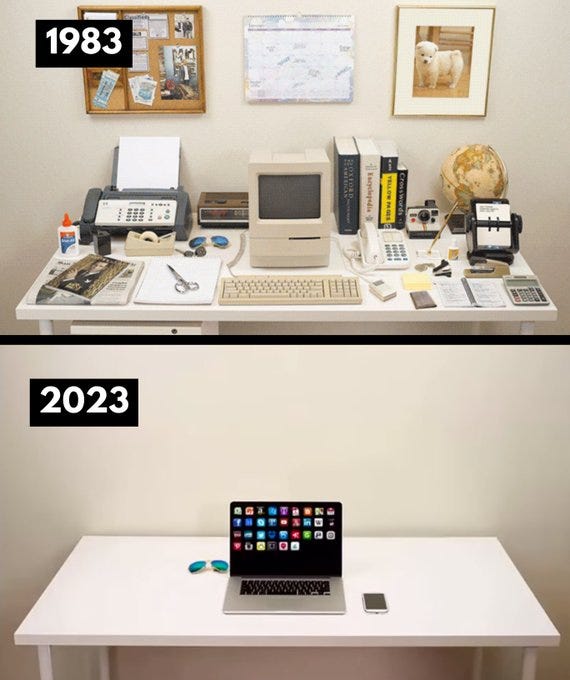
Ultimately, making convenience products more consumer-friendly requires an overhaul in design.
The first step is giving consumers more control over products and their implementations. Algorithms should prioritize giving consumers the ability to customize social media feeds or e-commerce searches, not driving them to the most profitable option by default. Bluesky, for example, allows users to choose how content is delivered to them — including a chronological feed of those you follow, several algorithmic ‘discovery’ options,3 and other feeds curated by other users. You also choose which feed you’re shown when you open the app. Additionally, tools that require data collection, like cloud-based email or life traffic updates, should make end-to-end encryption, de-personalization, and rigidly enforced permission settings standard.
Democratizing control over content is another way to enjoy digital convenience in a more pro-social manner. Streaming and social media should be owned by the artists, and/or a firewall should be erected between creation and distribution. Creators should own social media platforms. Platforms themselves should be governed as what they are — public utilities, not private fiefdoms. Placing power in the hands of users and creators forces platforms to prioritize the sorts of experiences we actually want, not what drives the most engagement.
Technology is value-neutral; the social context innovations are injected into is what shapes their impact. To see these design priorities widely promulgated, major structural changes will have to ripple through our economy. By prioritizing quarterly earnings reports, we’ve created an economy of short-term extraction over long-term value creation. A combination of breaking up oligopolies, enforcing competition policy, slowing down capital markets, introducing new rules and regulations, or forcing companies to democratize their ownership can brute force change. Moreover, the fact that consumers are so unhappy with these tools makes the space ripe for disruption, should social entrepreneurs heed the call. The recent success of the Fediverse, ProtonMail, and CryptPad is a testament to that fact.
Business models may need to be rethought, revenue strategies may need to be reworked, but in the end, these companies should work for us. If they can’t deliver convenient products under this framework, they should not exist. Consumers should not have to swallow enshittification or swear off technological progress. We are well within our right to demand that the future serve the people.
Further Reading

What I’m Reading, Watching, and Listening to
Green: This album, by Hiroshi Yoshimura, is an early example of the ‘nature ambient’ genre and has been instrumental in my quest to calm the heck down.
The Ghosts of Conservation Past: A detailed history of how the U.S. has shaped conservation policy and practices globally.
Even though I’m Gen Z, yes, I did experience pre-Cloud group writing . . . in middle school).
I don’t want to buy a separate GPS, camera, and calculator. And while I like buying CDs and DVDs as a hobby, I don’t want to consume all my media analogue style.
Including a ‘popular with friends’ and various ‘trending’ feeds based around different topics.