

Story Slamming!
A case study in community building

Since moving to the St. Louis area, one of the scenes I have become involved in is a monthly storytelling event called the Tamm Story Slamm. Inspired by The Moth radio program, this event was started by a guy in his backyard with a couple of friends sitting around the fire and telling stories from their lives to one another.
From those fireside performances, Tamm Story Slam grew into a monthly1 storytelling event with a stage, monthly themes, a bar, and a dog wandering around sniffing for dropped snacks.
I started attending Story Slamm earlier this spring through a local friend. For the theme Pride, I recounted how I was nearly struck by lightning, for Rebel, how I incited a dancefloor uprising, and for What I Wish I Knew, some incredibly stressful visa issues when I lived in China. As a member of the audience, I listened as people recounted hardships, remembered loved ones, and celebrated personal growth. Tamm Story Slamm is a place where St. Louisans can chronicle our lives together.
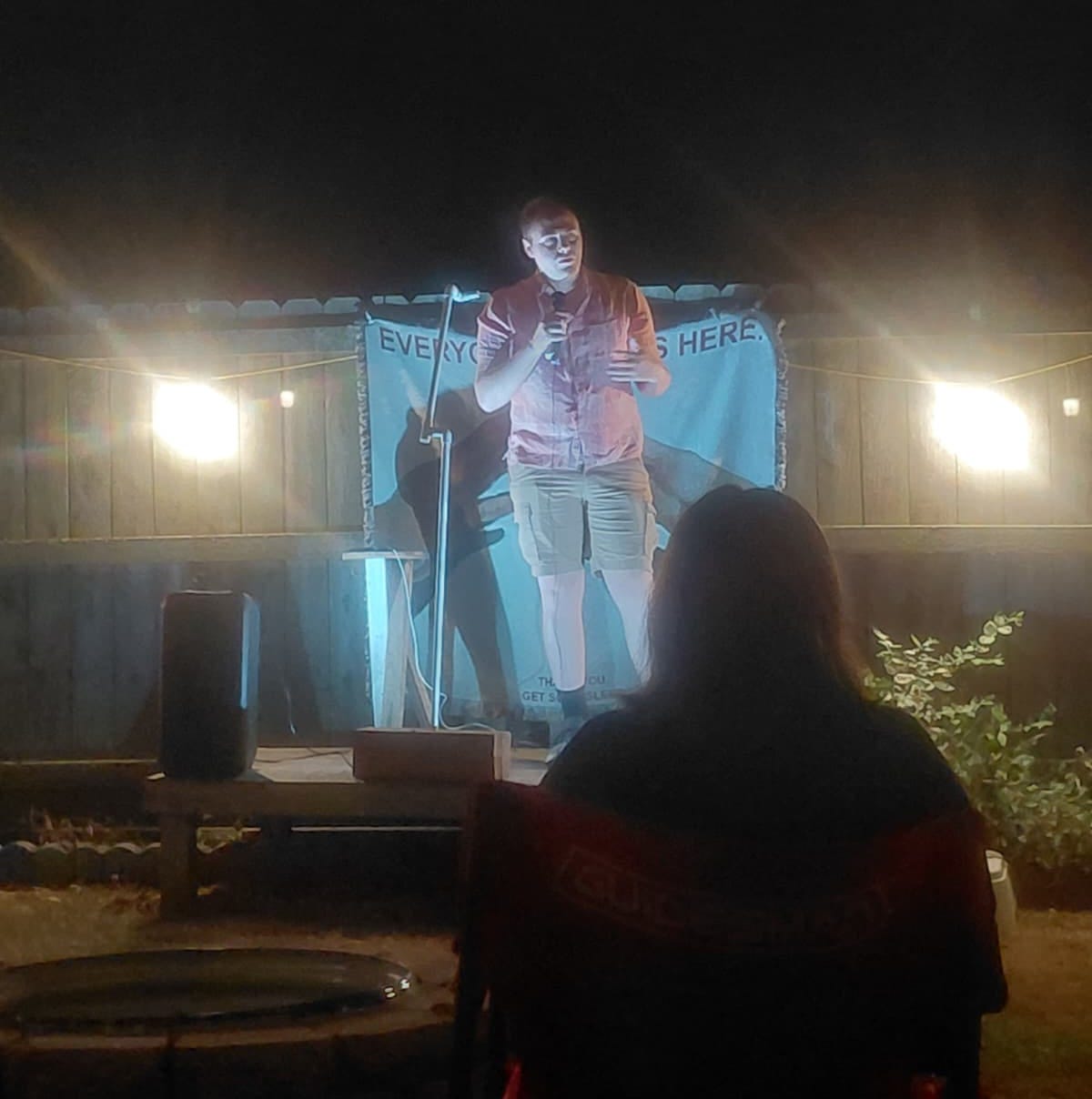
But the value of Tamm Story Slamm goes beyond its role as a nexus of story and performance. It also serves as a model piece of community-forming infrastructure!
Building a community requires both breadth and depth. Individuals need to interact with a lot of people around them, and they need to form stronger social ties with a subset of those individuals. In the sociological jargon, these are called bridging relationships. Someone with strong bridging networks meets lots of different people, allowing them to become familiar with lots of individuals and quickly develop a social base. This can become a valuable platform for affinity groups to form and for a heterogeneous collection of people to develop a sense of commonality. This bonding forms lifelong friendships and neighborhood solidarity. Recurring events like Tamm Story Slamm serve to link disparate groups and individuals together, acting as the central node facilitating these interactions.
Since I’m a huge nerd, I want to dig into why Tamm Story Slamm works so well as a piece of social infrastructure and try to elucidate some lessons as to how normal people can build community ourselves.
The foundational reason why Tamm Story Slamm works as a community-building endeavor is the combination of a consistent core of individuals, along with an ever-changing periphery of people who come and go. The core consists of the host’s family and close friends, and the periphery consists of those acquainted with that core group. Interactions between core and periphery members, along with periphery and periphery members, are what drive the formation of new relationships. The volume of unique interactions between strangers is quite high, but due to attending Story Slamm they share at least one thing in common – a love of stories. And since most people learn about Story Slamm through word of mouth, there is a high likelihood that two strangers will have more things in common. Either they know some of the same people, live in the same neighborhood, or share interests. The increased likelihood of shared affinities and affiliations broadens the friend-making potential of Story Slamm over that of a grocery store or library.
The other key component of Tamm Story Slamm is the presence of a consistent activity. The normal flow of a Story Slamm is that people arrive in the hour before storytelling begins, grab a drink, and chat with folks around them. During the storytelling, people obviously sit and watch, and afterwards, some people stay and continue to chat around the fire. It’s the negative space around the storytelling where the main bonding occurs. It may seem that, from a community-building perspective, the storytelling is ephemeral at best, but it is central to the endeavor. Having an anchoring point helps the flow of the night, pacing individual conversations and imbuing the ‘social hour’ with a lot more vitality than if the main event were merely hanging out.
Anticipation for the storytelling part of the evening is the source of this energy, providing people with natural icebreakers and a conversational pathway. Asking someone whether they will tell a story leads to various related topics. Folks can hint at the story they’ll tell, tell the rejected stories they decided not to use, bemoan how hard it was to come up with a story for a particular theme, or pontificate on their preference to remain an audience member. The limited time also creates a mild sense of urgency, allowing people to feel more empowered to cut off conversation when it gets stale and awkward, ending the interaction on a more positive note than if that urgency didn’t exist, better solidifying the interaction as a constructive exchange. During intermission or after the storytelling wraps up, people will often go up to one another and tell them they liked a particular joke or related to a part of the narrative, creating meaningful connections between individuals. Additionally, the storytelling aspect is quite a unique draw, bringing in more participants, especially distant strangers, than if the event were just hanging out in one’s backyard.
Finally, the regular schedule also helps the events function as a community-building endeavor. When spring comes around, the host makes an Instagram post with the season’s themes and on which Saturdays they will occur, allowing people to put them in their personal calendars. Regular themed posts in the weeks leading up to each event help remind people of the upcoming night and compel folks to practice their stories. With the business inherent in adulthood, the predictability and advanced notice make it more likely that folks can attend. As a bonus, the Instagram posts make it easy for someone to share the event’s details with their own friends, bringing more people into the fold.
By drawing in disparate but kindred individuals, providing them with a consistent activity around a predictable schedule, Tamm Story Slamm has laid out a strong model for how to fashion other community-building events. These lessons can help us scaffold our own grassroots community events that bridge the walls of friend groups and neighborhoods.
Storytelling events are a great activity to build community around, as narrative and performance communicate one’s values and make people seem more relatable (assuming the story itself has elements that are identifiable for the audience). Food is a similar locus for connection. For those wanting to build their own community-making event, starting a restaurant club, where a group of folks go to a different restaurant monthly or biweekly, is a great option.2 This has the advantage of not using one’s personal space but is still flexible enough to accommodate a shifting scene of individuals (of course, this requires getting a proper headcount before placing reservations). For the politically motivated, organizing a weekly ‘call your legislator,’ or protest planning night is a similarly good option. Book clubs, poetry circles, and craft meetups all fulfill the necessary qualities as well, as long as they are set up to encourage folks to drift in and out as they please.
Of course, not everyone is comfortable extending open invites to the public to enter their homes. Aside from the discomfort of having strangers in one’s bathroom or judging decorative sensibilities, there are real liabilities in opening your home to the public. In the event of an accident, like an allergic event, insurance may not cover issues if they find out said gathering was open to the public. Plus, there’s always the possibility of incurring the ire of one’s landlord or zoning board. More private-oriented events, where it’s invite-only but people are encouraged to invite friends and loved ones, are a good way to replicate the model while being a bit more controlled. Regular game nights, dinner parties, and PowerPoint nights all fulfill this mandate. Personally, I’ve hosted occasional waffle parties and fondue nights, and my partner and I are now hosting regular game nights where we meld together different friend groups, helping them get to know one another. Something with a bit of quirk to it can really help people latch onto the event as something unique and thus desirable to keep attending.
For those of us trying to bring people together and build community, we would be hard-pressed to find a better grassroots model than Tamm Story Slamm. Balancing recurrence, shared activity, and openness to intermingling friend groups and strangers is foundational to increasing a sense of rapport and solidarity amongst strangers, laying the groundwork for healthy communities.
For the enterprising social organizers, I recommend two episodes from the podcast Live Like the World is Dying about the logistics of community event planning. Organizing Outdoor Gathering Infrastructure and Putting on DIY Shows and Events.
What I’m Reading, Watching, and Listening to
American Kestrels put the Cherry on Top: Cherry farmers are using birds of prey to, not only keep other birds from eating their crop, but to also control the spread of food borne illness.
During the warm months.
My favorite version of this idea, which comes from disgraced physicist Victor Ninov, went to every Italian restaurant in Darmstadt, Germany (where he worked at the time) and ranked them based on their spaghetti carbonara.